
Long before The Loop, there was The Lincoln Club. The Lincoln Club was built on the Stewart Block in August 1898 and opened that same year.
Continue reading “The Loop Theater, 419 Superior St.”Indie Local History
Long before The Loop, there was The Lincoln Club. The Lincoln Club was built on the Stewart Block in August 1898 and opened that same year.
Continue reading “The Loop Theater, 419 Superior St.”
Ken R. Deutsch (“Ken R”) is a former Toledo-based radio broadcaster, jingle producer, and longtime enthusiast of the American radio-jingle tradition whose studio at 1806 Madison Avenue served as a production center from 1985-2000.
Continue reading “Ken R Music, 1806 Madison Avenue”
The expression “Central Avenue strip” was not unique to Toledo. In Los Angeles, Central Avenue had become a celebrated center of Black nightlife and jazz by the 1930s, and the stretch of clubs and businesses was subsequently remembered as the “Central Avenue strip.” The expression has appeared in a few other places as well, but in those instances strip is consistently lowercase. Only in Toledo have I found Strip capitalized.
Having some familiarity with the slogan, I was certain it got its start in the early 1980s. However, my initial research shows that it appeared as early as 1976.
Continue reading “The Central Avenue Strip”
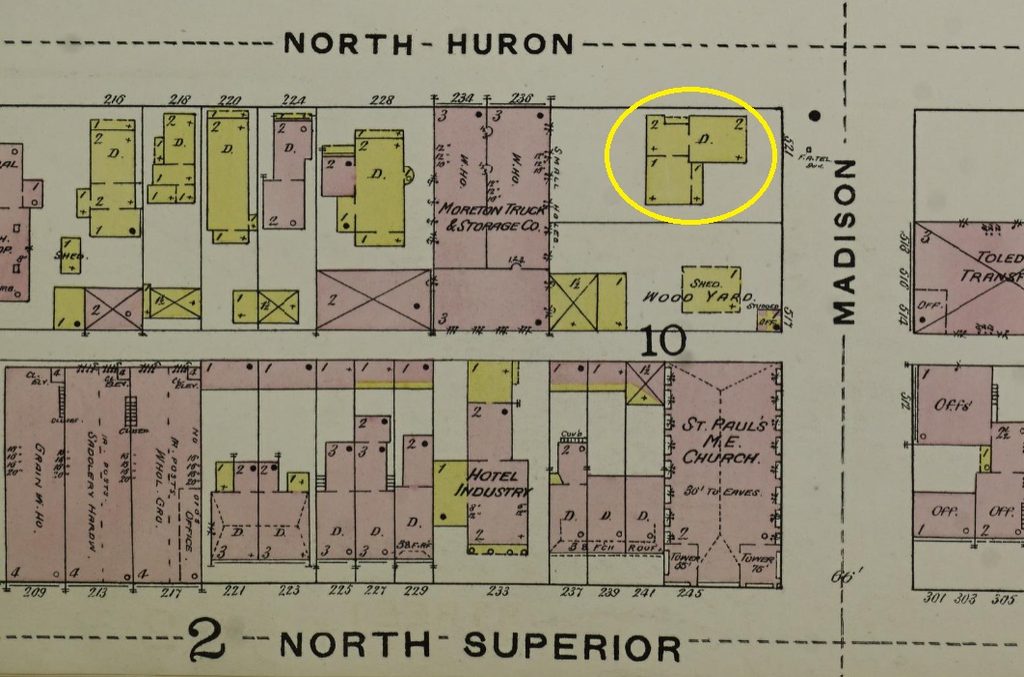
The John A. Stevens house was located at the corner of Madison Street and Huron Street. By 1874 it was the “former residence” of John Stevens and was converted into a boarding house.
Continue reading “Stevens House, 519 Madison St.”
The House of Hilton was owned by the late Jeanne Hilton. It was originally located at 2840 N. Reynolds Road c1974. The business was relocated to 2234 N. Reynolds c1978. Susan Hilton was also co-owner of the business. Closed c2008.
Continue reading “House of Hilton, 2234 N. Reynolds Rd.”
In 1861 this land was still owned by Emmeline Wadsworth. In 1875 it was owned by Jeremiah Micham (1822-1898) and in 1888 by Riley Micham. A map from 1900 shows a house on the property facing Holland-Sylvania Road. Charles Micham, the brother of Riley, owned the land on the south side of his brothers property. Henry Haefner married Louisa Gerner in June 1897 in Lucas County. By 1910, the Riley property was the home and farm of Henry and Louisa Haefner.
Continue reading “Henry G. Haefner Farm, 2830 Holland-Sylvania Rd.”
The Lindsey farm was located on the southeast corner of Central Avenue and the Maumee Road (now Holland-Sylvania). In 1875 the land was owned by Robert Freeman. Lindsey purchased the land between 1875 and 1888.
Continue reading “William Lindsey Farm, 3016 Holland-Sylvania Rd.”
The Woolco in the image above is not our Woolco, but it sure looks a lot like it. The image of the vacant building below is where our Woolco once was.
Continue reading “Woolco Department Store, 5821 W. Central Ave.”
Joseph Wampler
In 1820, surveyor Joseph Wampler was making his way through the area that would, in 1895, be known as Rattlesnake Corners, or simply “The Corners.” Today, we know the intersection as Central and Holland-Sylvania. The black dot in the 1820 capture above represents the intersection.
Continue reading “From Plain Lands to Private Hands: Long Before ‘The Corners’”