Built c1947. Demolished c2021.
Continue reading “Kauffman Home, 3514 Moffat Rd.”Indie Local History
Built c1947. Demolished c2021.
Continue reading “Kauffman Home, 3514 Moffat Rd.”
The fuel tanks at the back of the mobile home suggest this was a residence. It’s assumed that whoever lived here was likely associated with the Kujawa residence to the right in this image (5918 Bonsels Pkwy).
Continue reading “Kujawa Property, 5924 Bonsels Pkwy.”
Built c1940. Demolished c1989. Currently a small office building.
Continue reading “Tirrith Home, 3433 Holland-Sylvania Rd.”
Built c1944. Demolished 1990s. Currently another car wash.
Continue reading “Foster Home, 3503 Holland-Sylvania Rd.”
Back in the ’80s there was a small cluster of dirt mounds behind the Kmart at 5956 Central Avenue. Perhaps about five to ten of them, about four or five feet high and maybe ten feet in diameter. Over the years vegetation and small trees grew on them.
Continue reading “The Kmart Dirt Mounds”
“Generally fair and warmer tonight and Sunday, fresh winds, becoming southerly.” That was the forecast for the evening of April 14th, 1900 when Kate and her sister Johanna sat down for dinner. The day before Easter Sunday.
At about 7 o’clock that evening Henry Wendt, a farmer, was standing at the well on his property when he saw a women crawling slowly up the road toward his house. He recognized that it was his neighbor Miss Kate Sullivan. As she approached, Wendt was shocked to find her covered in blood from head to foot and gagged with a strip of red tablecloth. Wendt took Kate into his home and tried to untie the gag but found it so tight that his wife had to cut it off with pair of scissors. Her hair was hanging down and clotted with blood. She had multiple wounds on her head and blood was flowing from them all. A doctor was called to the Wendt farm but by 6am Sunday morning Kate was dead.
Continue reading “The Sullivan Farm”
Being that 428 10th Street is being demolished, we thought we’d post about it.
The Child Study Institute (CSI) in Toledo, Ohio, was a long-running Lucas County juvenile detention and evaluation facility tied to the juvenile court system. CSI on 10th Street opened in 1953. The structure was designed by the Toledo architectural firm Bellman, Gillett & Richards.
By 2000 CSI was described in the Toledo Blade as being “plagued by problems from deteriorating plumbing, aging heating systems, poorly secured detention areas, and outdated court areas.” In March 2001 operations were transferred over to a new juvenile detention center at 1801 Spielbusch Avenue. By May of 2001 equipment and fixtures at the “Old CSI Bldg” were being auctioned off. The building was used as storage over the years but eventually ended up on the Toledo Fire & Rescue Department’s Code Red list. A Code Red building is in such disrepair that it’s a danger to emergency personnel. Asbestos contamination got CSI put on the list.
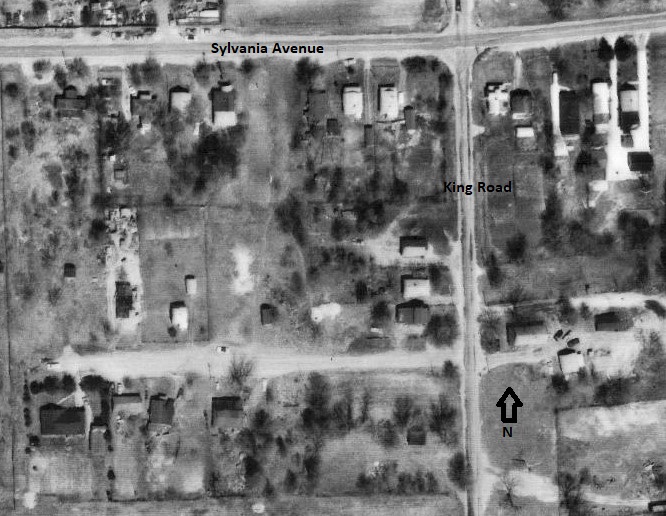
Continue reading “Child Study Institute (CSI)”Deanville was a small residential neighborhood and historically significant African-American settlement located at the southwest corner of Sylvania Avenue and King Road in Sylvania Township.
Continue reading “Deanville”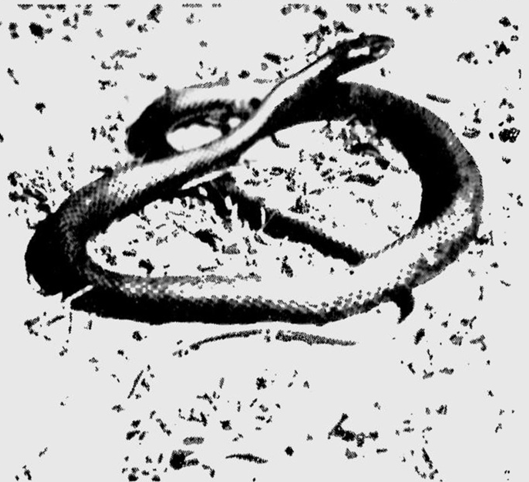
Before development, the area around present-day Central Avenue and Holland-Sylvania Road in Sylvania Township, historically known as “Rattlesnake Corners,” was a flat, marshy landscape along the edge of the historic Great Black Swamp. An ideal habitat for the Eastern Massasauga rattlesnake, or “swamp rattler,” the region consisted of wet prairie, sedge meadows, marshy ground, scattered oak openings, and poorly drained lowlands interspersed with slightly elevated prairie ridges. Tall grasses, cattails, shrubs, tamarack, and oak groves would have covered much of the land, while shallow seasonal ponds, muddy depressions, winding creeks, and groundwater-fed wetlands provided excellent overwintering habitat in crayfish burrows and saturated soils below the frost line. This blend of wetlands and nearby drier hunting areas supported abundant frogs, mice, voles, and other prey, creating an ideal environment for massasaugas long before drainage projects, farming, roads, and suburban development transformed the area.
Continue reading “Rattlesnake Corners and the Eastern Massasauga”
In October of 1895 Fred and Alvina Behrendt took over operations of a roadhouse/tavern at the crossroads of what is now the intersection of Central Avenue and Holland-Sylvania Road, then called Rattlesnake Corners, or “The Corners,” for short. I won’t repeat here what has already been written about in great detail in 1895.
Continue reading “Rattlesnake Corners and Fred Behrendt.”